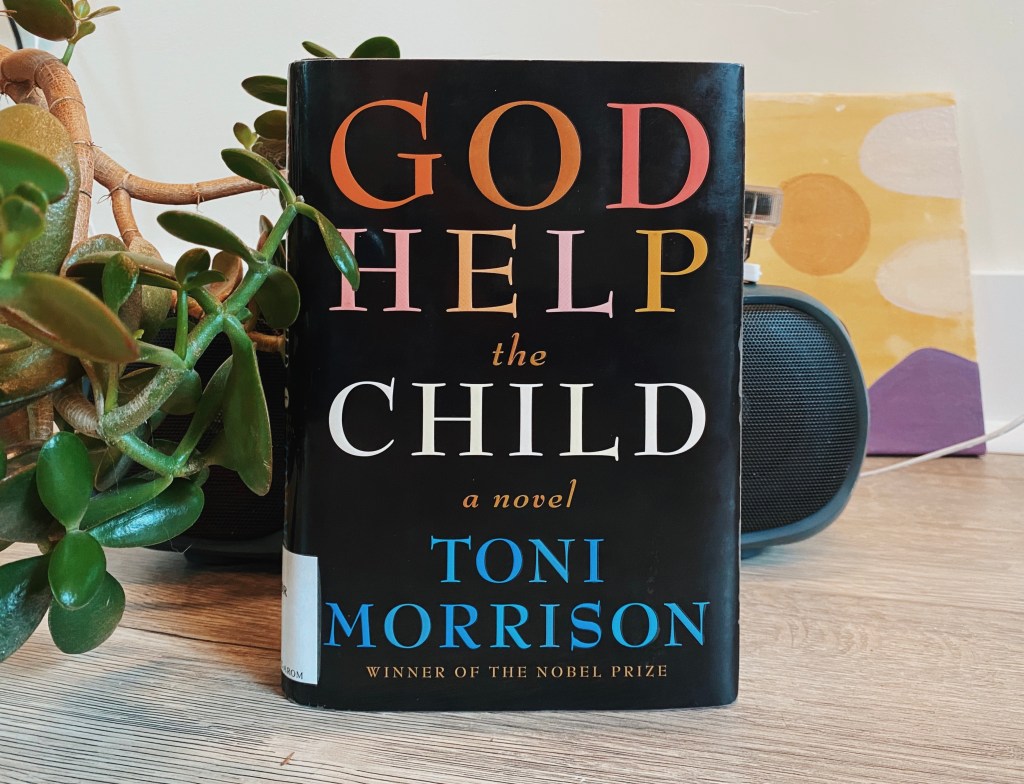
“Each will cling to a sad little story of hurt and sorrow— some long-ago trouble and pain dumped on their pure and innocent selves. And each one will rewrite that story forever, knowing the plot, guessing the theme, inventing its meaning and dismissing its origin.” (Morrison, God Help the Child, 158)
Toni Morrison’s God Help the Child tells the story of trauma and how it shapes a person’s life. It’s cast of characters include Lula Ann (Bride), her mother whom she calls “Sweetness”, her friend Brooklyn, her lover Booker, his aunt Queen, an ex-convict Sofia and a little girl, Rain. Each of them has experienced painful events that have profoundly shaped who they are and how they perceive the world. Morrison shows the misunderstanding, tension and even violence that can erupt when a person’s unique trauma response meets another’s. The novel weaves together their multiple different narrative perspectives, with Lula Ann/Bride as its central character. Through her characters’ eyes, Morrison shows a few key ways a person can deal with trauma, starting with the most classic, narcissism and victimhood, to healing, to a mix of bitterness and peace.
Sweetness: Narcissism and Victimhood
Lula Ann has been deeply traumatized by her parents: her father abandons her and Sweetness is openly revulsed by Lula Ann’s deeply black skin.
The novel opens with Sweetness’s perspective on Bride’s birth. Its opening lines read: “It’s not my fault. So you can’t blame me. I didn’t do it and I have no idea how it happened. It didn’t take more than an hour after they pulled her out from between my legs to realize something was wrong. Really wrong. She was so black she scared me. Midnight black, Sudanese black. I’m light-skinned, with good hair, what we call high yellow, and so is Lula Ann’s father. Ain’t nobody in my family anywhere near that colour” (3).
Instead of joy, Sweetness reacts with horror and most of all defensiveness, as if her baby’s skin colour was an indictment of her, of some serious biological or moral flaw that Lula Ann’s blackness has exposed to the world. Sweetness spends the entire rest of the chapter justifying why and how she is the victim of Lula Ann’s blackness: her family has always experienced racism while doing whatever they could to distinguish themselves from other coloureds, society hates black skin, her husband left her because he suspects she cheated on him and Lula Ann embarrasses her everywhere she goes just by being that black. The chapter begins and ends with “It’s not my fault”. As we continue to read the rest of the book, it becomes increasingly clear that Sweetness is a narcissistic, abusive and neglectful mother who has deeply traumatized her daughter while continuing to play the victim. She never owns up to or apologizes for the ways she has hurt Lula Ann. While Sweetness’s repetitious “It’s not my fault” initially ostentatiously refers to the colour of Lula Ann’s skin, I cannot help but wonder if she is subconsciously deflecting blame for the way she has mistreated her own child, admitting to a guilt she refuses to verbalise.
While Sweetness is not one to sit with and process heavy emotions, it is quite apparent through her tirade that she and her family has struggled badly on account on being Black. For her, she takes her immense bitterness and scapegoats Lula Ann with it. Lula Ann’s black skin becomes a symbol of the whole gamut of problems and pain that racism in society and her family has caused her.
Lula Ann and Booker: Moving Towards Healing
Lula Ann’s trauma affects every aspect of her life, from her choices of lovers, friends and career to the way she dresses and names herself. She chooses fake friends, emotionally shallow relationships, runs a cosmetics brand and wears all white as a way of beautifying her black skin. These choices reveal respectively her inability to choose safe people, her attachment issues and obsession with her appearances, the part of her she got rejected by her own parents for.
Booker’s unresolved issues stem from losing his brother to a child killer and rapist, and having that grief and horror be dismissed by the rest of his family instead of listened to. Eventually, Lula Ann and Booker have a violent confrontation, where they begin to see each other for the first time. At the end of the novel, they look forward to raising their child together in a world where they can rewrite the narrative.
At some point in her life, Lula Ann changes her name to “Bride”, a nickname free of “Lula Ann” the little Black girl she used to be and free of any last name tying her to her family of origin. At the same time, she dresses only in all white, as if she were perpetually in a state of marrying into a new family. At the end, the little girl in her finds some peace, and she continues to seek some measure of connection with Sweetness, albeit on her own terms (she does not give Sweetness too many personal details). Finally, with Booker, Lula Ann has a chance at realising her aspirations of re-creation, as they continue to heal and move forward.
Queen: Somewhere in the Middle
Queen lies somewhere in the middle of Lula Ann/Booker and Sweetness. She is estranged from all her own children and seven ex-husbands. She is able to treat Lula Ann and Booker with kindness outwardly, while she still harbours bitterness in her heart. Even as she encourages Lula Ann to confront Booker and fix things, she still believes “They will blow it… Youth being the excuse for that fortune-cookie love—until it wasn’t, until it became pure adult stupidity” (158). She projects her own failures on them.
Nevertheless, the love she expresses to Booker and Lula Ann is enough to make them feel supported and they return the favour by ensuring she dies surrounded by love. Despite her cynicism, she is able to live and die with some measure of peace.
All the key characters in God Help the Child are in many ways deeply hurt have their own unique ways of dealing with it. By displaying a wide range of human responses to pain, Morrison invites us to choose for ourselves who we sympathise with and which moments and tendencies we see ourselves in.
Ultimately, Morrison suggests that healing comes down to appropriate expression, the choice to work through the mess and the bold attempt to rewrite the narrative. Even if it leads only to moments that are somewhat okay and messy compromises, it might be enough.

