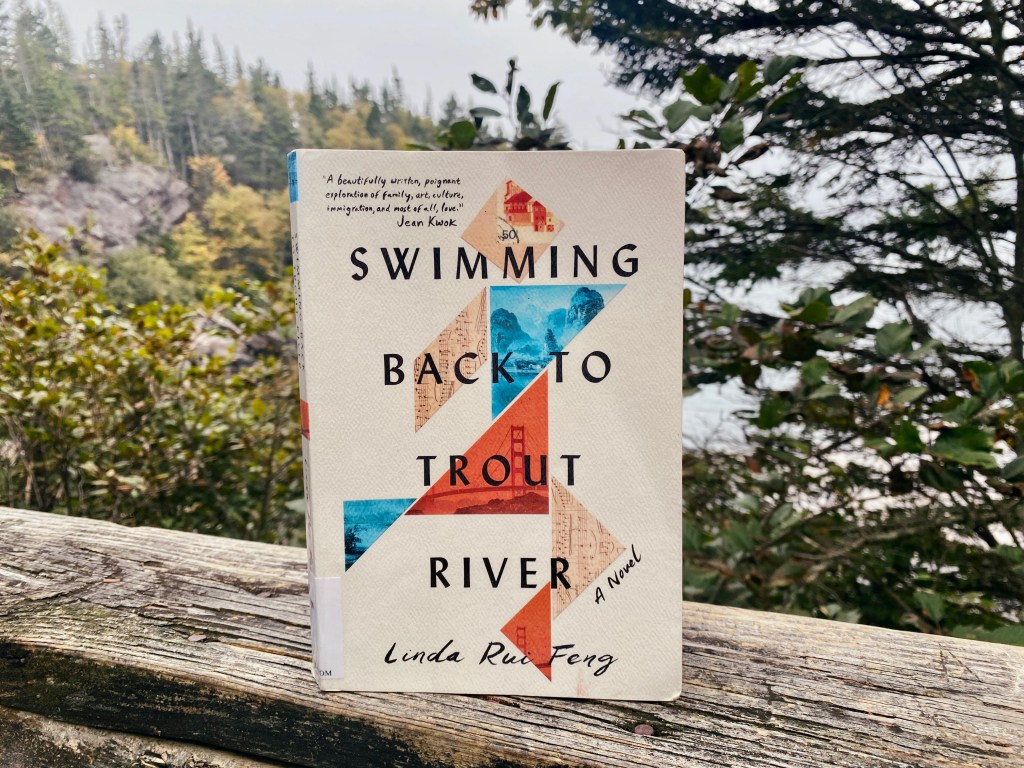
Swimming Back to Trout River by Linda Rui Feng is a novel about relationships and ambition set against the backdrop of the Chinese Cultural Revolution and the Chinese diasporic experience. Its narrative spans generations, decades and continents. At the center of Feng’s cast of characters is a three-generational family: Momo and Cassia, who meet in Beijing and then move separately to America, their daughter Junie, who doesn’t have legs below the knees and Momo’s parents, who raise Junie in Trout River village.
Momo, who survives his childhood against the odds, turns out to be the village’s golden boy. He is the first from the village to be accepted into a university—in Beijing, no less. At school, he is highly successful, academically and socially. He is so entrenched in the value system of the Cultural Revolution that that system becomes inseparable from who he is. He brings the spirit of the revolution into every relationship and everything he does, including the way he speaks and sees things. He is utilitarian and patriotic to a fault. Momo’s one-track mindset is so all-consuming that he lacks the mental space for the empathy and creativity required to understand others.
In contrast, his wife Cassia is sentimental and superstitious. She is the kind of woman who checks with a fortune teller before she gets married. Because of her sentimentality, she holds on to many things from the past. The clash of their two value systems leads, beginning at the onset of their marriage, to secrets and rifts between them that widen imperceptibly, until the gap is too wide to cross. Caught up in his belief that only his way of seeing things is correct, Momo fails to understand Cassia, or grasp whenever she drops hints about what really goes on in her inner world. When Cassia consults superstition, Momo refers it as “these things”; that she “really ought to know better”; “it’s just a coincidence” (88). He dismisses Cassia’s need to anchor her life in the supernatural as quirky, or ignorant. He fails to realise that superstition is central to Cassia as a woman, that (as is revealed to us readers and not to him), she interprets her entire life through fate and hidden messages.
Even, or especially, with Junie, their gazes stay fixed in opposite directions. Momo sees in Junie future delight and potential: “He… began to form notions about where to go from here… He found himself trying to anticipate her next move, her next expression, but always ended up surprised. If it weren’t for the rest of us, it suddenly dawned on Momo, all her life she’d never know anything was missing” (93). On the other hand, Cassia sees Junie’s birth as a message from the past: “The universe was trying to tell her something, through him. Because nothing was a coincidence” (157). Momo is so caught up in relentlessly marching forward and Cassia so trapped in the past, that they both miss the present, each other and Junie herself. For a large portion of her text, they are both physically separated from each other and their daughter. There are usually long spans of time that elapse in the novel’s narrative between their two different versions of events, physically representing the gap between them.
When the novel is told from Momo’s perspective, the narrative style is impatient and demanding. When it is told from Cassia’s perspective, the paragraphs meander slowly between past and present; they labour under the effort required to superimpose meaning from one onto the other. It is only with Junie that that the narrative seems to breathe and expand. Free of the burdens her parents carry, Junie’s world is bright, lively and colorful. She notices the sounds of the earth, the changing faces of the river. She writes, “I hear crickets everywhere” (205). In comparison to her parents, Junie is almost shockingly present to the immediate world around her. There is none of the complicated stories her parents spin around everything. In many ways, although she is less physically able, she is more alive than them, more in tune with herself.
Momo, Cassia and Junie therefore symbolise the three tributaries of time— future, past and now. In crossing these different streams, Swimming Back to Trout River often leaves many ends loose, and the reader is invited to draw their own connections, or not. These unexplained things remind us that not every story needs to be told and that not every silence needs to be filled with words. Sometimes, what can determine a trajectory can be as simple as the sound of a cricket in a bamboo cage, a blue mushroom. Reaching across a wordless gap to hold on to another’s hand. It may be just enough to listen, to look and maybe, to touch.

