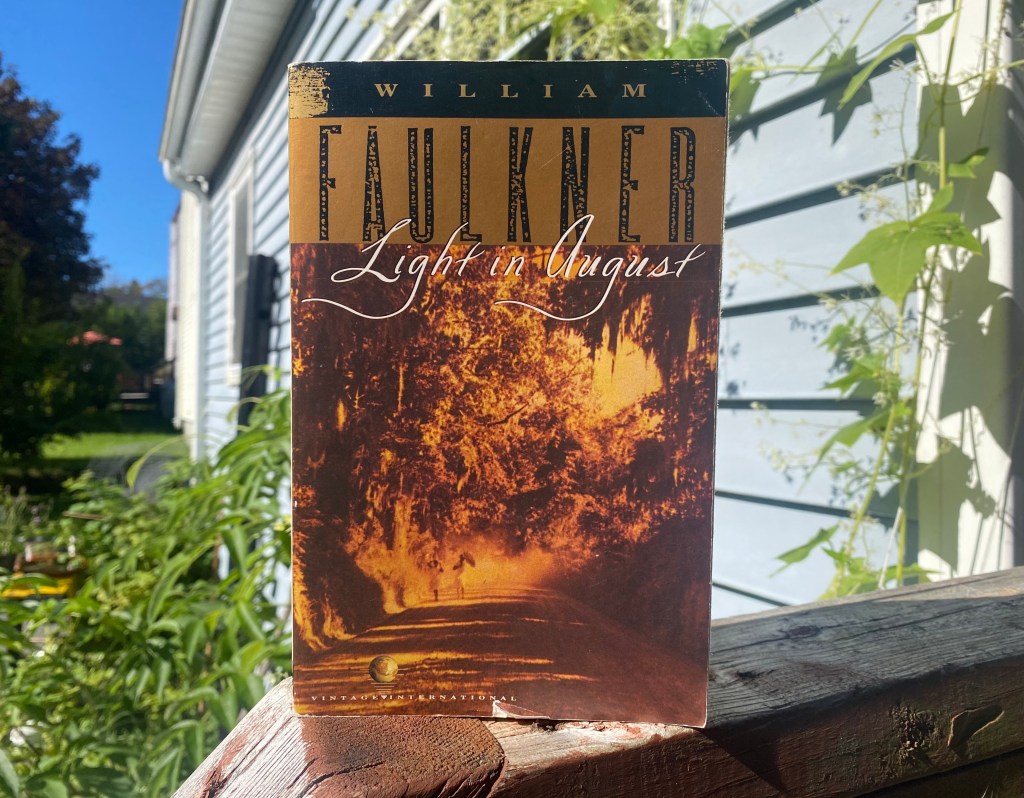
Light in August begins with Lena Grove traveling along a road on her way to Jefferson to find the father of her baby, Lucas Burch. They are not married and as we discover later, Burch had lied to her, about marrying her and settling down together. Lena never questions this made-up future, this promise of happiness always on the horizon but never within reach. Throughout the text, Lena is almost always alarmingly placid, almost always completely trusting. Somehow, despite her general ignorance of the world, people are always stepping in to aid her and her baby. There is always someone there to protect, clean up, or at least witness. Her journey begins and ends Light in August like parentheses to all the other goings-on. Both structurally and narratively, her fruitless quest frames the other characters’ stories in Light in August. Thus, I cannot help but think that Faulker invites us to view everything that happens in between through the lenses of 1) attempting to fulfill something, however fruitless the attempt and 2) a person’s relationship with community.
Light in August is peopled by a multitude of characters, quite a few seemingly equally important: Lena, Byron Bunch, Gail Hightower and Joe Christmas. The main one I will be focusing on is Christmas.
In contrast to Lena, who is protected and surrounded by mostly good intentions, is Joe Christmas. Christmas is one of the main characters in Light in August and its most tragic. He is part black, part white, and because of that is an outcast. He feels like an imposter when he is amongst Whites and when he is amongst Blacks. He spends his life harassed and objectified. For a while, he lives on Joanna Burden’s property. She is the daughter of an abolitionist and participates in many pro-Black movements, which at first suggests that this may be where he finds some measure of peace and acceptance. However, after they get sexually involved, Burden objectifies him as specifically a Black male (sexual) object. No matter where Christmas goes, he cannot escape being othered.
One of the most notable features of Light in August’s narrative style is that much of what happens is told by one character to another. Bunch finds out about what happened to Hightower because someone told him. Christmas’s grandmother tells her story to Hightower. We keep up with Lena as she settles in Jefferson and with Burch’s progress because Bunch keeps Hightower regularly updated. Burden tells the story of her family to Christmas.For a lot of this novel, in order to find out what has happened, we are forced to eavesdrop on these sometimes highly intimate conversations. As readers, we are the invisible listener in the room. Sitting there with the other listening characters, we see the sweat on their faces, we feel the heat of the dying August light through the window. This narrative style is almost claustrophobic, mimicking the atmosphere of a gossipy small town. Faulkner’s characters are highly dependent on those around them. It is the community that a story goes through in order to reach a person. The story (reality) is shaped by the community. The characters’ existences which these stories define is held within the web of everyone else’s realities and stories.
In this regard, Christmas is a distinct outsider. Whenever his story is being told, it is told in the third person by a faceless narrator. No other character is ever there to listen to his story. Structurally, this reflects how intensely lonely he is. He never gets to tell his story or even be the sympathetic subject of a told story. When others talk about him, he is but an objectified patchwork of their racist ideas. By telling his story this way, Faulkner makes us readers his only witnesses, demanding that we give the verdict on him. This is especially striking when Joanna Burden dies. We do not see the moment of her death, but we are provided with the evidence of the rest of Christmas’s life and have to decide for ourselves, based on what we know of him, if we believe he is guilty.
At one point, Burden asks Christmas how he knows for certain that he is part Black, to which he admits he does not. In fact, a White bystander remarks at one point that Christmas looks no more Black than he does. Does this mean that for his whole life, if he wanted to, he could have lived passing off as a White man? In that case, his entire wretchedness might well have been born out of an idea being given so much weight that it took shape and form around his whole life.
This fatal tendency is one mirrored in many of the other characters: Burden with her inability to separate herself from her family’s legacy, Hightower in his obsession with his grandfather, Bunch in his blind devotion to Lena.
In the end, after Christmas has been shot dead for apparently killing Joanna Burden (again, there is no actual proof of this), Lena continues on with her journey out of Jefferson, chasing the empty promise of Lucas Burch who has absconded. Byron Bunch, who is just as susceptible to castles in the air, throws everything away and follows her in her quest for another man, protecting and serving her while he gets continually rejected.
All in all, Light in August is a journey to, through, and out of Jefferson, not only its geographical landscape but also its human one. In Lena’s brief time there, we witness Faulkner’s attempt at dissecting a wide scope people all ensnared in their inescapable human natures. He shows how subject a person can be to an idea, or a story, while being blind to the manacles that they have created themselves. The tapestry of his heedless characters serve as a reminder that when we witness another’s destruction, we are but looking at a reflection of our own.

