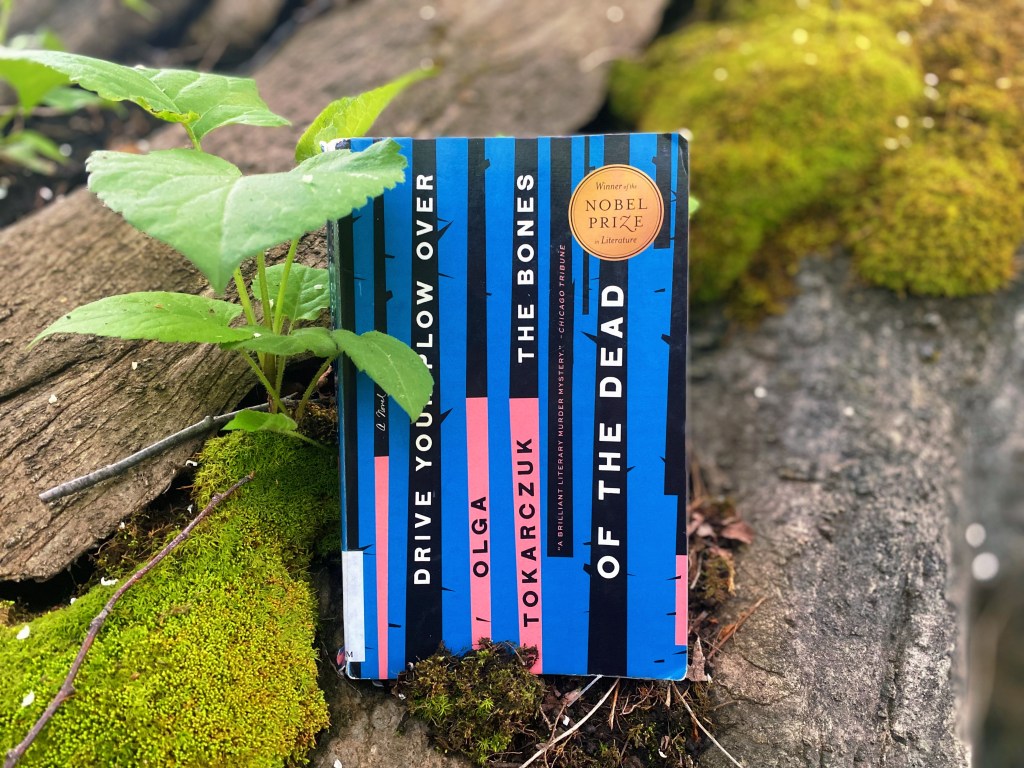
Olga Tokarczuk’s Drive Your Plow Over the Bones of the Dead is an ecocritical novel examining the ways in which the natural world is deeply interwoven into human lives. In fact, it questions if there even is a divide at all. This novel explores the topics of anthropocentrism, ecocriticism, utilitarianism and feminism.
The novel presents the different layers in which nature can affect humans. On the largest scale, there is astrology, where some believe that the alignment of the planets at the moment of a person’s birth determines their character, the trajectory of their lives and the day they will die. Somewhere in the middle are the medium sized things: the changing seasons and the behaviours of animals we coexist with, by choice and by chance. The smallest natural phenomenon Tokarczuk’s characters encounter is the Cucujus haematode: a “small, brown, quite average-looking bug” (153). These beetles do not do anything; they simply exist in trees. Their simple, non-useful existence mirrors that of many people that are invisible to the wider society. People who do not make waves; who simply exist and are easy to ignore.
While these are common enough tropes, Tokarczuk complicates matters: the novel’s events are portrayed through an unreliable— unstable?— elderly narrator, Janina Duszejko. To many in her village, she is but a “crazy madwoman”. While being able to see from a character’s perspective is usually meant to evoke sympathy for them, Janina makes sympathising with her pretty hard. Both outwardly through her interactions with others and inwardly in her thoughts, she appears tempestuous, impulsive and deeply judgemental. I personally struggled to like her— till the end, she stubbornly clings to her own (illogical?) convictions and remains entirely unswayed by anything anyone else who disagrees with her might have to say. In fact, she is so indoctrinated in her own twisted perspectives that it causes her to devalue and despise other humans who live lives in conflict with hers.
Presenting supposedly noble or easily acceptable ideas through such a character refracts them through the lenses of feminism and ageism. At the police station, where Janina lodges a report about a boar she found shot dead, she gives a speech about animal cruelty and the violence and murder inherent in killing animals and eating their meat. While these ideas may be taken seriously perhaps in a university lecture on ecocriticism or a Ted Talk, Janina is dismissed. The guard says, “I find it truly puzzling. Why is it that old women… women of your age are so concerned about animals? Aren’t there any people left for them to take care of? Is it because their children have grown up and they don’t have anyone to look after anymore, but their instincts prompt them to care for something else? Women have an instinct for caring, don’t they?… Take my granny, for example. She has seven cats at home, and she also feeds all the local cats in her area” (107). There is truth in what Janina says— animals suffer and feel pain and fear. There is undeniable violence and cruelty involved in the ways we farm them for meat. However, the package she comes in — elderly and female— makes her diatribe easy to dismiss. Her compassion for and recognition of animal suffering is regarded as feminine instinct and empty nest syndrome.
While the ways she treated by many suggest a character meant to evoke sympathy, Janina is in many ways unlikeable. The reader’s sympathy is tested and stretched to the limit, especially when it is revealed that she murdered three people. Together with the unspectacular Cucujus haematode, this “crazy madwoman” orchestrated the disposal of three powerful individuals.
At the same time, there are characteristics and features that make Janina likeable and—in contrast to how she sees herself— pretty useful. For example, she presents a deep sensitivity to and appreciation of nature. She treasures creatures great and small, tracking and observing their movements, apparently for the pure pleasure it brings her. She also earns her living as a guardian and caretaker, taking care of her neighbours cottages through the harsh winters while they shelter in their homes in the city. She makes her rounds daily, ensuring the bridge hasn’t been washed away and that her neighbours’ homes do not get destroyed by the storms, snow and melt. By doing so, she allows them to continue having their summer escapes in safe abodes. When a neighbour she dislikes dies, she and another neighbour tenderly dress him and make him decent for the cops and his funeral. Like the seemingly insignificant Cucujus haematode, Janina is valuable when you look at her through the right lens.
Her killing of the humans, juxtaposed with her deep appreciation and care for nature, begs the question: how is human murder any more wrong than the hunting and killing of animals for meat and sport? Her acts of murder— she insists that she was merely carrying out the animals’ revenge— may speak to how she views all life equally, a radical perspective.
Suffice to say, Janina is a mixed bag, and Tokarczuk invites us to make the final judgement on this strange character. Is Janina a well of wisdom, or a rambling, batty old fool? Is she a cold-hearted killer? Or is her perspective right— that she is but a tool for the natural world, her guilt only amounting to that of cornered animals when they strike back?
In all, Tokarczuk shows the complications that can arise when someone presents an anti-anthropocentric stance and makes us question the manmade distinctions between human and nature and what makes something “valuable”, or “wrong”.

