“Yes, in the immense confusion one thing alone is clear. We are waiting for Godot” —Samuel Beckett, Waiting for Godot
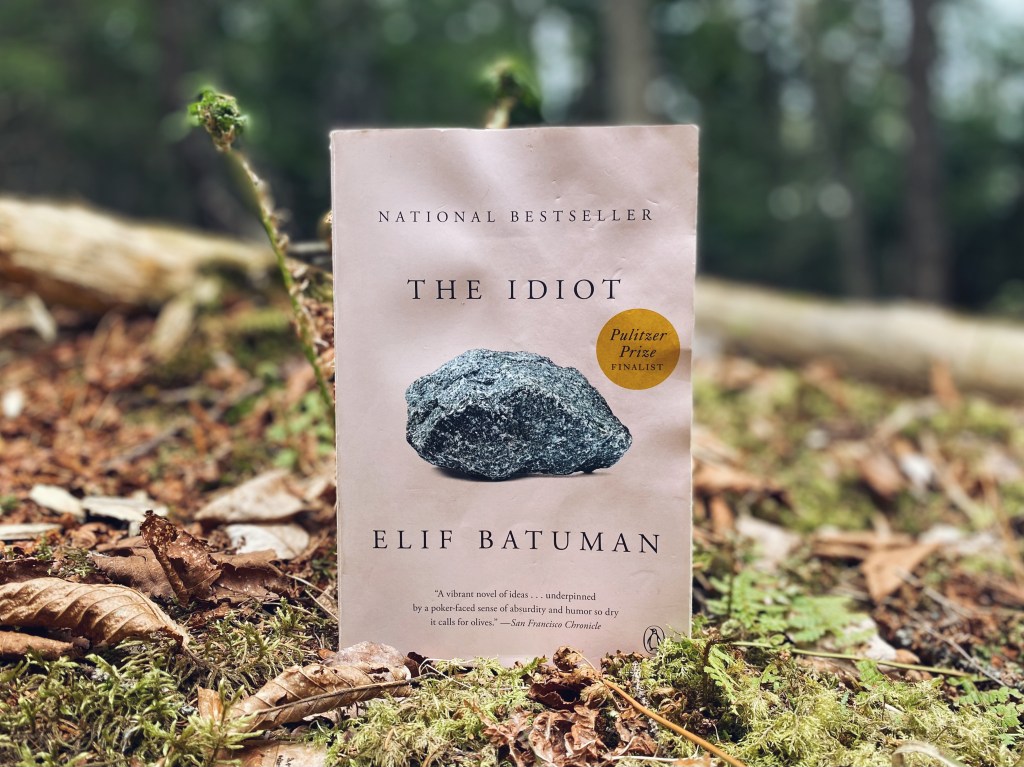
A year ago, I picked up Elif Batuman’s The Idiot from a little free library in the corner of a playground off a highway exit. It had just rained the day before and the books in there had gotten wet. The first half of the book is wavy with dried rain and the top of the spine is peeling slightly. Similarly, Batuman’s protagonist, Selin, increasingly finds herself stranded at seemingly random, out-of the-way spots and mired in obscure situations, as she travels from America to Hungary and finally to Turkey. Alongside the key events that drive its plot forward, The Idiot is rife with small innocuous details Selin (delightfully) notices, such as a child crying outside a church, dogs barking in other people’s yards, the changing weather. She notes that there are momentous events that make you feel extremely alive, and that they bookmark the emptiness and stasis of everything else. Indeed, the novel spends a lot of time on everyday, and at times unglamorous, places, thoughts and occurrences.I can’t help thinking that the way in which I found The Idiot echoes the character of Selin’s life: misshapen and slightly damaged but delivering an absorbing adventure nonetheless.
The central thing in her life and the one that inflicts the most damage is a Hungarian boy she meets in Russian class, Ivan. One day, Selin writes an email to him, starting an epistolary online relationship. In their emails, they wax lyrical about poetry, language and other complex inner thoughts. Although their in-person friendship was initially casual and relaxed, it morphs into the inverse of their online relationship: Ivan pretends not to notice Selin when they encounter each other in person and becomes increasingly distant and cold. For a while, they persist in this strange way, sending long emails at odd hours while ignoring each other’s physical presences. Selin’s mind and body get thrown into turmoil; she develops severe insomnia which affects her daily functioning. When she and Ivan finally try to have a real in-person relationship, however, things don’t flow nearly as smoothly as they did online.
On their first date, they sit in a crammed courtyard drinking iced coffee that Selin dislikes, eat some dirty strawberries on an island in the middle of a highway and have a lousy cafeteria dinner (156-163). Finally, their date ends unceremoniously when Selin remembers she has to rush off for an event she only half-heartedly wanted to be at in the first place. The date is tangibly uncomfortable. Throughout, Selin keeps getting hit with the realisation that Ivan is a real, living, breathing human being: “It was insane to me that he even ate everyday, and that he was going to do it now” (163).
A Fable About Online Relationships
On the one hand, Ivan and Selin’s relationship is a tale as old as email and social media: boy and girl have an online relationship that is abstracted from, and so much better than, the actual messy thing. Then, when they try to make it real and concrete, they are met with disappointment. Their conversations are halting, the food is bad and they have to constantly deal with awkward moments and questions, such as whether Selin wants to change out of her wet bathing suit with Ivan around. Selin views their emails as deep conversations rife with meaning, and lets this abstract relationship chart significant portions of her real life, including her eventual decision to temporarily teach English in a remote Hungarian village. Ivan, however, is more factual about the reality of their email exchanges: that it was nearly meaningless in terms of building a relationship. While drunk, he admits to her, “We took turns, but basically you wrote something, and I wrote something else, and then you wrote something else. It was never really a conversation”, adding, “It was better” (386-387).
Indeed, their emails do very little in the way of getting them to actually know each other, something another character, Rozsa accuses Selin of being bad at. Selin constantly struggles to think of questions to ask any conversation partner. Selin and Ivan’s correspondence basically comprises back and forth monologues. This relationship is inherently selfish, based on getting to explore their own thoughts in a safe zone in front of a silent and appreciative audience rather than human interaction under the duress of being face-to-face with another flesh-and-blood person. Selin and Ivan don’t even interact with the other’s thoughts when they reply to the emails.
In this vein, Selin and Ivan’s relationship is a cautionary fable about online affairs. They show how the ability to (pretend to) conduct a relationship behind separate screens allows for ‘ideal’, impersonal and false relationships, a phenomenon we can observe everywhere today.
What is Real?
On the other hand, their relationship is a study of what makes something real and how reality is invented. Can we write it into being?
As Selin and Ivan begin emailing each other, they are also reading a story in Russian class that mirrors and portends the disappointments to come. In the story, a woman, Nina, follows her love interest, also named Ivan, to Siberia. When she arrives there, she finds it incredibly difficult to locate Ivan and for a long time, fails to have an actual confrontation. She even runs into someone with almost the exact same name, who is not the Ivan she seeks. Significantly, Selin fails at first to notice this detail: “As I read, it came back to me that this wasn’t the right Ivan— it was another Ivan with almost the same name. What a stupid detail to put into the story, I thought” (68). Ironically, this “stupid detail” foreshadows her later discovery that the Ivan in his emails is not the same Ivan she eats dirty strawberries on a sad highway island with. She tries to find the wonderful, faultless Ivan of poetic descriptions and late night emails and finds instead a regular guy who laughs at others’ misfortunes, who is absent-minded and is, according to her mother, “a womaniser”. She and Ivan both fail to turn an abstract ideal into a similarly desirable reality.
Ivan is a math major, a subject I have commonly heard as being the antithesis to literature (a view I vehemently disagree with). My favourite passage in the book is on page 250, where Selin’s friend Svetlana draws the connections between Ivan’s math and his and Selin’s relationship. She tells Selin, “You think language is an end in itself. You don’t believe it stands for anything… He’s cynical in the same way you are, only more so because of math… math is a language that started out so abstract, more abstract than words, and then suddenly it turned out to be the most real, the most physical thing there was. With math they built the atomic bomb. Suddenly, this abstract language is leaving third-degree burns on your skin “(250).
While it is true that there is a dichotomy between the “false” online relationship and the “real” in-person one, and that the former lives only in Selin’s head, there is also truth to Svetlana’s words—that the abstract can inflict lasting and even physical damage on the real. Even before Ivan and Selin start hanging out in person, Selin suffers from real, damaging insomnia arising from their email exchanges. Their abstracted exchanges leave real wounds. Later, she admits to Ivan that she avoided seeing him for two weeks, telling him, “sometimes, after I see you, I feel really bad… It’s almost physically painful” (386).
She then realises that both she and Ivan seem happy when they discover they have hurt the other person and she is confused by it: “Why was it fun for us to make each other suffer? Did that mean it wasn’t love? Surely that wasn’t what love was?” (386). Instead of being proof of “fun”, I would argue that their happiness comes not from some twisted view of love, but from relief over the proof that something between them is actually real, like the “third degree burns” on the bomb victims. At least in this respect, they are on the same page, and it is this fact that makes them happy.
The Idiot’s plot is all-consuming and often fragmentary—it weaves together many apparently disjointed events over the course of a school year and summer. Keeping up with all of Selin’s multiple commitments was at times as demanding as keeping up with my own. In this way, Batuman’s book feels extremely realistic, overwhelming the reader with both the crucial and banal. Things get forgotten and then randomly remembered. Selin tries to hold on to as many details and facts as possible, weaving them into something resembling a coherent narrative. She admits to Svetlana that it is because she and Svetlana are privileged that they can afford to make up stories at all— “Isn’t it more about how much money our parents have? You and I can afford to pursue some narrative just because it’s interesting” (367).
Waiting for Ivan
Selin spends some time in Turkey with her four aunts near the end of the book. She makes an observation about these women: for them, the main event was waiting for something to happen or change. In contrast, the main event itself they treated as trivial or “just a side diversion” (417). While Selin notes this characteristic dismissively, she is remarkably similar to these aunts. She makes Ivan the main event in her life— the personification of her misguided longing and hopes. Everything else in her life– the real things— such as her adventures in Hungary, are all peripheral to him, just side diversions from an abstracted concept she keeps trying to make real and keeps getting disappointed by. She spends so much of her free time thinking about Ivan; indeed it seems to be a hobby of sorts for her. When she does something, she at times appears to almost sleepwalk through it, possibly accounting for the fragmentary, disjointed style of The Idiot’s narrative. While her aunts wait for things to happen, Selin waits for this Ivan to become the ‘other’ Ivan, the one who fulfils her desire for human connection and a real romantic relationship.
The ending of The Idiot is vague yet symbolic: by quitting linguistics (language), does it mean that Selin has given up on the false world she and Ivan tried and failed to write into reality? She admits that she “hadn’t learned anything at all” (423). The failure she hints at perhaps refers to her shortcomings as a halfhearted ESL teacher and concurrently, the failure of language (the email affair) to be anything more than abstract (lead to a real romantic relationship).

