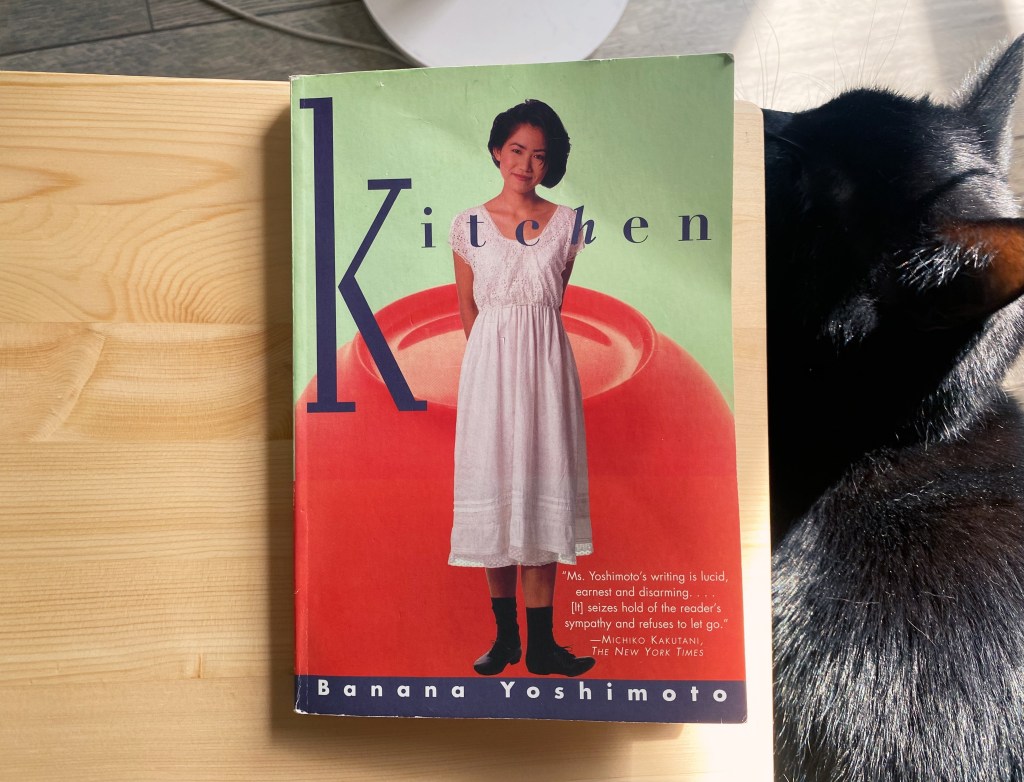
“That she had come to me at the end of a long night of misery made me want to cry tears of joy. I wanted to tell her: ‘How happy I am that you came to me like an apparition in that bluish mist. Now everything around me will be a little bit better when I wake up.’ At last I was able to fall asleep.” — Banana Yoshimoto, Kitchen, “Moonlight Shadow”
Kitchen by Banana Yoshimoto is a slim volume comprising two novellas, “Kitchen” and “Moonlight Shadow”. Both of them feature heavily the idea of being cast adrift in a dark sea by unexpected tragedy and the importance of others during these dark times.
In “Kitchen”, Mikage’s grandmother dies, leaving her without any living relatives in the world. Alone in the house, she finds that she can only sleep beside the refrigerator in the kitchen. Out of nowhere, the Tanabe family, made up of Yuichi and his mother Eriko, take her in. In many ways, Yuichi and Eriko begin to turn on all the lights one by one in Mikage’s life again. They do so unobtrusively through a combination of their easy ways, their undemanding companionship and how they give Mikage a family to care and cook for again. She begins to sleep easier and look forward to living again. Later, when tragedy strikes Yuichi, Mikage returns the favour, ensuring that he remains connected to normal life, even as he tries to sink beneath the waves of his despair and isolate himself. She goes the distance, quite literally, to get to him when he needs her most, ensuring that he does not drift away for good.
Similarly, human connection at just the right time and place functions as a life raft amidst tragedy in “Moonlight Shadow”. The novella’s main character, Satsuki, has also suffered a crippling loss. Two key people, Hiiragi and Urara, find her in her aloneness. Hiiragi gently extends the lifeline of his care and presence, trying in his own grief-addled way to prop her up. As for Urara, her appearance and behavior in Satsuki’s life is so distorted by a fever the latter has that it is unclear if Urara is the product of a fever dream or real. Furthermore, the gift on the bridge that Urara gives Satsuki is distinctly otherworldly. Real or not, however, it was a crucial step Satsuki needed to take, in order to turn the corner in her healing journey.
Urara’s presence and actions straddle the line between the real and the supernatural, symbolising how other people’s presence in our lives in difficult times are as crucial as divine intervention. The bridge in “Moonlight Shadow” is particularly poignant, emphasising how having genuinely supportive and loving relationships—even temporary ones— can carry us over turbulent periods that may otherwise drown us.

