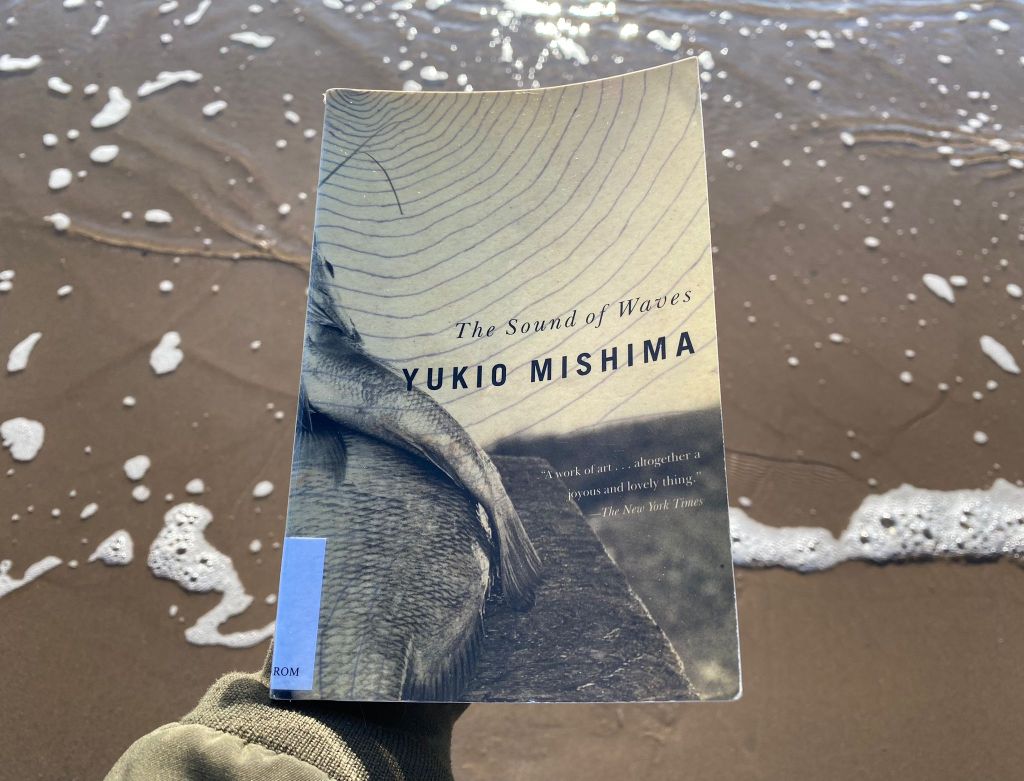
Yukio Mishima’s The Sound of Waves is about two young lovers, Shinji and Hatsue, on the Japanese island Utajima who overcome many challenges in order to be together. It is framed as a classic medieval love story: a prince seeks a princess locked away in a tower. To win her, he has to prove his worthiness, valour and strength by slaying the dragon that stands guard over her.
Shortly after they fall in love, a jealous girl who likes Shinji spreads a rumour that him and Hatsue slept together, a taboo in conservative and small Utajima. This false story spreads like wildfire. Eventually, it reaches Hatsue’s father, Terukuchi Miyata. Furious, he locks the girl up, forbidding the couple from meeting. Yasuo, an arrogant and rich competitor to Shinji, also does his best to sabotage the relationship, first by fanning the flames of the gossip, then by attempting to both rape and court Hatsue. The villagers’ disapproval, Terukuchi’s measures and this highly threatening competition thus constitute the dragon which Shinji must slay in order to earn his princess.
The battle rages in little, drawn out ways throughout the book, finally coming to a head when Terukuchi devises a test to choose between Yasuo and Shinji. He puts them both in the same boat under the same apprenticeship as a test of their characters, although this is not revealed to the two boys. Things come to a head when a huge storm hits and one of the lines anchoring the boat to a buoy snaps, putting everyone in danger. While Yasuo cowers, Shinji cheerfully offers to swim out to the buoy in the storm to tie a new line to it. He dives head first into the typhoon and with the sheer force of his physical and mental strength, he succeeds in his task. This scene is highly symbolic: Shinji strips off his raincoat— his protective covering— and chooses to meet danger, the unknown and his fear in the face. Mishima drags it out too, emphasising how great the threat to Shinji’s life is: “Then, standing in the bow, he stared down at the sea. Down beneath the spray, down beneath the white caps that beat themselves to pieces against the prow, there were the jet-black, invisible waves twisting and coiling their bodies. They kept repeating their patternless movement, concealing their incoherent and perilous whims.” (162)
This moment is where Shinji proves his might against the metaphorical dragon. Furthermore, the storm is also an allegory for all the challenges Shinji has to overcome in order to get Hatsue. The roiling, “patternless” waves represent the villagers’ responses to their relationship— unpredictable and completely out of the couple’s control. Shinji’s courage in the face of a literal and figurative tempest serves as proof of his valour and worthiness. As such, Terukuchi awards him Hatsue and open approval, allowing a happy ending for the couple.
Beyond this main narrative, the novel also contains some commentary about the lives of the island’s other inhabitants. These include juxtaposing the male vs. female experience, city vs. country life and the different ways of making a living— primarily: fishing for the men and pearl diving for the women. In all, both the men and women appear to be hardy, resilient and capable of harsh labour. As good people, Shinji and Hatsue both prove in different ways to be physically strong and brave in the face of all challenges, suggesting that a person’s nature and physicality go hand in hand. Consequently, characters who fail to meet up to these standards— in particular the two who attempt to sabotage Shinji and Hatsue’s relationship— prove to be shameful losers in the end. As such, this is also a story about character and the forces of good and evil as they are personified through the different individuals of Utajima.
In all, The Sound of Waves was a pleasure to read. Mishima delivers these classic Romance tropes with almost an ascetic, pure quality. Furthermore, Shinji and Hatsue’s love story is presented alongside an eloquent tribute to Japan’s natural beauty. Romance aside, the novel persistently and lovingly guides attention to Utajima’s natural landscapes— the sight of clouds, the music and beauty of the waves, the island’s jagged and stark cliffs. The narrative is liberally peppered with sentences that just sing, like, “the sea was a place where, instead of waving heads of rice or wheat, the white and formless harvest of waves was forever swaying above the unrelieved blueness of a sensitive and yielding soil” (19). The scenery is described with such stunning, loving attention, it is as if the author is inviting readers to take in the views as they read. It feels like I am sitting on a train or a boat moving leisurely through the island, looking up at these postcard-worthy sights before turning back to the book in my hands.
 Hephzibah Grace
2 thoughts on “Yukio Mishima’s The Sound of Waves: The Knight Who Slays the Dragon Gets the Princess”