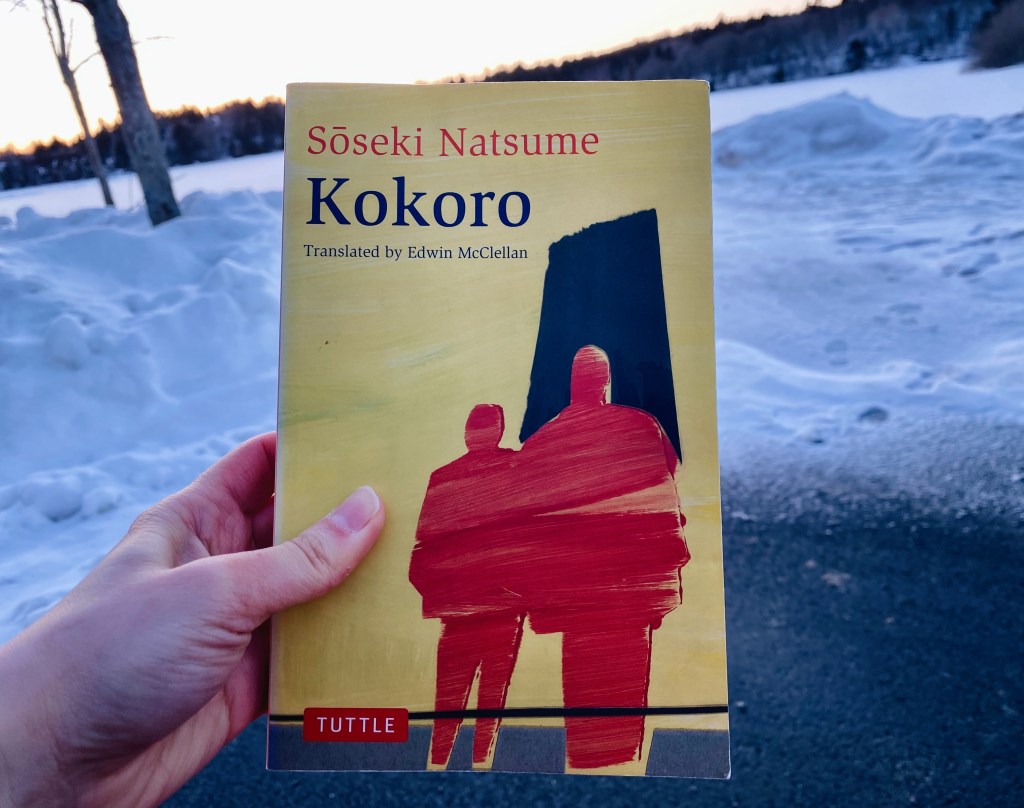
I read Kokoro in the last week of 2025. Between the backdrop of the end-of-year cold and gloom and the book’s increasingly intense plot, reading it felt like I was gripped in a fever dream.
The story starts off unassumingly enough: the unnamed protagonist, a college student, spots Sensei swimming in a vacation town and they acquaint themselves. The protagonist has the usual set of banal troubles of his own— exams, ageing parents who don’t understand him and youth. In the midst of all this, he adopts Sensei as a mentor of sorts, looking up to Sensei more than he does his college professors and his own parents. He visits Sensei as often as he can, trying to learn from him about life. While a lot of Kokoro’s plot at the beginning features his and Sensei’s conversations, Sensei remains a somewhat peripheral figure to his life for a while.
As the story progresses, the protagonist’s curiosity is piqued— by innocuous things Sensei says that later keep nagging at him, or by his conversations with Sensei’s wife. All these clues slowly begin to snowball, suggesting that what Sensei shows him is but the tip of a much bigger iceberg. Sensei and the protagonist’s lives become increasingly entwined and the mysteries of Sensei start to unravel in ways that shock and challenge our views of everything. While reading Kokoro, I had some thoughts:
On Idolatry
Sensei once tells the protagonist: “The memory that you once sat at my feet will begin to haunt you, and in bitterness and shame you will want to degrade me. I do not want your admiration now, because I do not want your insults in the future. I bear with my loneliness now in order to avoid greater loneliness in the future.” (30)
Placing another person on a pedestal requires that we see ourselves as lower than them. Indeed, the protagonist definitely idolises Sensei and rarely thinks critically about anything the man says. While he may ponder, “what did Sensei mean?”, he hardly ever asks, “is what he said true, or good?”. He presents Sensei as a wise sage, full of wisdom and self-control. If Sensei ever shows any excitement, the protagonist may wonder about it briefly, but it hardly affects his preferred image of Sensei as entirely calm and inhumanly detached, which seems altogether opaque and un-nuanced. Very much like an idol would be. In many ways, Kokoro’s portrayal of Sensei probably reveals a lot more about the protagonist than about Sensei himself.
On Sensei’s Wife
For most of Kokoro, Sensei’s wife remains a nameless background figure to Sensei. She is portrayed throughout as docile and obedient, like a perfect doll. She is also clueless. Sensei is as opaque to her as he is to the protagonist. With the book’s final revelation, the protagonist ends up knowing even more than she does. For all of the protagonist’s admiration of Sensei, he fails to pick up on or comment about Sensei’s objectification of his wife.
The opacity surrounding Sensei and his wife shows how idolatry requires intentional blindness, towards a person’s negatives such as patriarchal values and misogyny. At the same time, the initial enigma surrounding Sensei functions as a plot device, creating a mystery to unveil, making the final reveal more climactic and gripping.
On Human Nature
Does Sensei’s dark back story discount all his present good qualities— wisdom, the ability to detach and a unique perspective on the world? Do they mean he deserves degradation and shame instead of admiration, as he so fears?
It may be true that these ‘dark’ origins gave rise to his current characteristics, i.e., that these traits may not be pure, as they spring from a bad root. But their current manifestations, as the protagonist experiences them, seem to be sincere. The contrast between the final product and the manufacturing process begs the question: can we admire character for what it is now, despite the choices and circumstances that give rise to it?
At the same time, I also wonder if the current Sensei is as a unique and brilliant a figure as he appears to be, or if the protagonist’s portrayal of him is coloured by his own personal, unquestioning idolatry of the man.
The atmosphere in Kokoro is one I thoroughly enjoy in most modern and postmodern Japanese literature I’ve read— a turbulent sea of tension and turmoil roiling beneath an apparently calm, almost unusually detached exterior. Kokoro was published during the modern era, and like many books from that period, it worries about the way the changing times encourage ego, freedom and independence in dangerous ways. However, it seems pretty clear from literature long after and before this period that these negative tendencies arise much more from human nature, instead of any specific time period. Sensei, the protagonist and all of us in our failings and triumphs, are products, not so much of our times, but of our own inescapable human natures.
 Hephzibah Grace
this book has been on my list for years but I never really committed to it. I’ll be picking it up soon, thank you for the review!
LikeLike
I hope you enjoy it! It is very worth it
LikeLike