In 2025, I read a total of 13 books, including audiobooks as well as a notable essay. They were, not totally in order:
- Ring, Koji Suzuki
- The Vulnerables, Sigrid Nunez
- Sputnik Sweetheart, Haruki Murakami
- Stoner, John Williams
- Lizard, Banana Yoshimoto
- I’m Glad My Mom Died, Jenettte McCurdy (audiobook)
- On Keeping a Notebook, Joan Didion
- Notes of a Native Son, James Baldwin
- Life for Sale, Yukio Mishima
- The House in the Cerulean Sea, T.J. Klune (audiobook)
- Butter, Asako Yuzuki (audiobook)
- The Makioka Sisters, Junichiro Tanizaki
- The Metamorphosis (and other short stories), Franz Kakfa
- Kokoro, Soseki Natsume
The year was quite activity-centric for me personally and as a result, my reading list wasn’t very deliberately curated. Many of these books were chosen on the spur of the moment and now looking at this list, I wish I’d taken more time to carefully select each book! While experiencing and chasing a full life outside of reeading was so good for my well-being, the books I read are, for me, nearly just as valuable. Reading takes time, and like many other things, puts content in my head that truly shapes the way I think and see the world, for a while or permanently.
However, I did emerge with a few favourites at the end of the year. These are what they were, in order:
The Best Books I Read in 2025
5. The Vulnerables, Sigrid Nunez
My first of Sigrid Nunez’s. I went to the library with the intention of borrowing The Friend (like many others, I am sure), and only found The Vulnerables, and was I ever glad I did after I read it. It was funny, enlightening and so very witty. The Vulnerables is part essay, part memoir. The main arc of the story documents Nunez’s life during the covid lockdown. This serves as a backdrop to her musings about several topics, including: life, friendship, generational differences, ageing, writing and the relationships between human and animals— she pet-sits a parrot for a friend as part of her lockdown experience. My favourite parts of this book were her descriptions of a deserted city, her at-first tentative friendship with a boy, Vetch, who shares the place with her and her discussion of Joan Didion’s “Slouching Toward Bethlehem” essay.
My favourite quote: “Asked: Whom would you want to write your life story: Someone with a gorgeous style and a great big loving and forgiving heart”.
4. On Keeping a Notebook, Joan Didion (an essay)
“On Keeping a Notebook” is a short essay that can be found both online and in Didion’s book Slouching Toward Bethlehem, the rest of which I have not read. In it, Didion shares about notes she has made in her several notebooks and muses about the whys and whats behind them. Ultimately, she writes that our notebooks are the keepers of ourselves and the selves we used to be.
My favourite quote: “We forget all too soon the things we thought we could never forget. We forget the loves and the betrayals alike, forget what we whispered and what we screamed, forget who were were. I have already lost touch with a couple of people I used to be…” (139, Slouching Toward Bethlehem)
3. Notes of a Native Son, James Baldwin
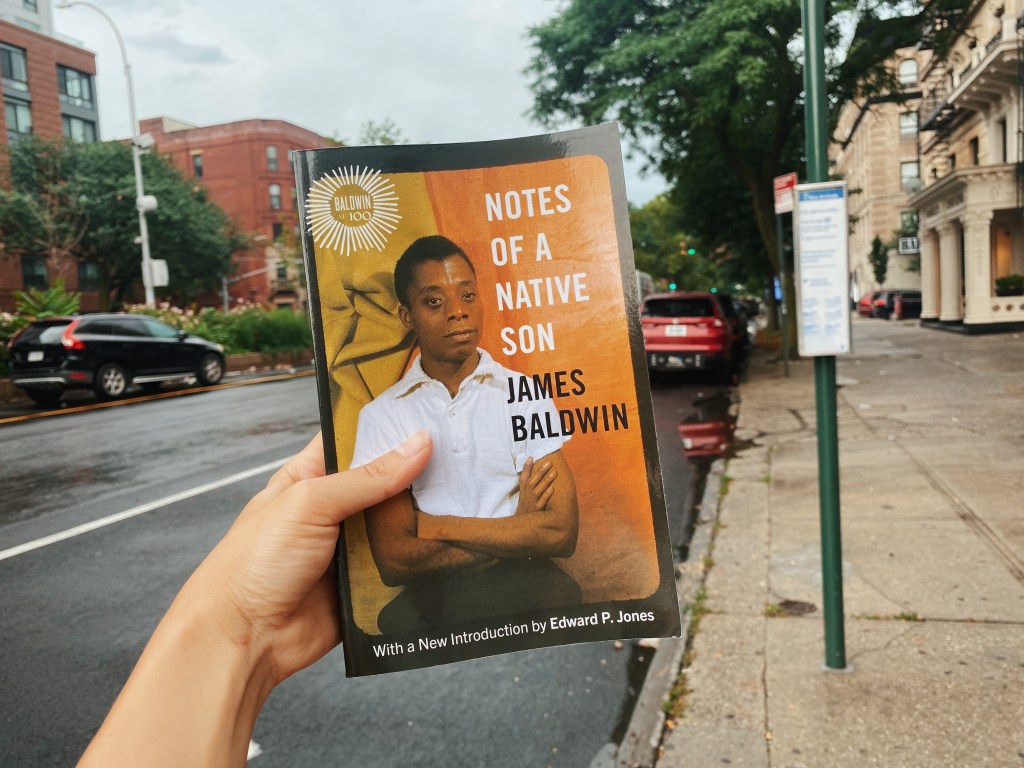
On our second day in Manhattan in the summer, we went to The Strand, the bookstore I’d been dreaming about visiting for nearly ten years, and I bought: Notes of a Native Son (James Baldwin), Satantango (Krasznahorkai), The Makioka Sisters (Junichiro Tanizaki), The Unbearable Lightness of Being (Milan Kundera), Kokoro and Botchan (Soseki Natsume), Madness, Rack and Honey and Dunce (Mary Ruefle) and Delicious Hunger (Hai Fan). I immediately commenced reading Notes of a Native Son back at our AirBnBs in East and then West Harlem, at bus stops, on the subway, in cafes and at Central Park. I managed to read more than half of the essays in it, including the titular essay. I am convinced that there is no better city in the world than Manhattan to read James Baldwin in. There, you can breathe in the atmosphere of the book as you are simultaneously immersed in it. As you look up from its pages, you look around at the same buildings, sidewalks and streets Baldwin himself walked and wrote about.
As always, Balwin’s writing has a powerful, pounding quality that takes my breath away. I am now living in a place where I am “a minority” for the first time in my life, and while I am not a Black person living in New York, his words resonated with my experiences on a level they never had before. He has a way of cutting an issue wide open with a precise hand, and laying bare its beating heart in plain, undeniable terms.
My favourite quote: “In our image of the Negro breathes the past we deny, not dead but living yet and powerful, the beast in our jungle of statistics. It is this which defeats us, which continues to defeat us, which lends to interracial cocktail parties their rattling, genteel , nervously smiling air: in any drawing room at such a gathering the beast may spring, filling the air with flying things and an unenlightened wailing. Wherever the problem touches there is confusion, there is danger. Wherever the negro face appears a tension is created, the tension of a silence filled with things unutterable. It is a sentimental error, therefore, to believe that the past is dead; it means nothing to say that it is all forgotten, that the Negro himself has forgotten it. It is not a question of memory. Oedipus did not remember the thongs that bound his feet; nevertheless the marks they left testified to the doom toward which his feet were leading him. The man does not remember the hand that struck him, the darkness that frightened him as a child; nevertheless, the hand and the darkness remain within him, indivisible from himself forever, part of the passion that drives him wherever he thinks to take flight” (30, “Many Thousands Gone”).
2. Stoner, John Williams
I wrote a post about this book here. Stoner tells the story of William Stoner’s entire life, in which he seems to me to trudge along half-dead most of the time, except for his love for academia and the brief, failed affair he has. This portrayal of a mediocre life, in which nothing of significance is reached toward or attained, asks: what makes a hero, or a heroic life?
Williams’ writing is meditative and all-consuming, exactly the kind of writing I adore, and I definitely want to read all the other books he has written.
My favourite quote: “You’re bright enough… But you have the taint, the old infirmity. You think there’s something here, something to find. Well, in the world you’d learn soon enough. You, too, are cut out for failure; not that you’d fight the world. You’d let it chew you up and spit you out, and you’d lie there wondering what was wrong. Because you’d always expect the world to be something it wasn’t, something it had no wish to be. The weevil in the cotton, the worm in the beanstalk, the borer in the corn. You couldn’t face them, and you couldn’t fight them; because you’re too weak, and you’re too strong. And you have no place to go in the world.” (31)
- The Makioka Sisters, Junichiro Tanizaki
The Makioka Sisters is a modern Japanese novel set in the late 1930s to early 1940s. It follows four orphaned sisters from a traditional, formerly upper class Japanese family on the decline as they, like the rest of Japan, get slowly consumed by the tide of modernity. It is told from a third-person limited perspective through various characters in turn, mainly Sachiko’s, the second sister. From her privileged position as a housewife of a successful man, she watches and tries to navigate the ways her three sisters make their ways through the changing times.
In The Makioka Sisters, Tanizaki not only tells the story of the sisters, but paints a picture of Japan and Japanese culture as they get reshaped over the course of the five years the book takes place in. Tanizaki shows Japanese attitudes changing towards traditions like annual cherry viewings and arranged marriages.
The book’s setting is beautiful; together with the characters, we get to pause and take in Japan’s beautiful scenery: Sachiko’s garden through the seasons, the views from the train to and from Tokyo, the cherry blossoms and fireflies in the grass on a hot summer night.
My Reading Wishlist for 2026
Although I rarely stick to a reading plan, I wanted to at least have a list of books to choose from this coming year. I want to read more intentionally and read better books than I did last year and hopefully, a list of books I am under the impression are good will help.
- The Myth of Sisyphus, Albert Camus
- Native Son, Richard Wright
- The Book of Goose, Yiyun Li
- Books by Han Suyin
- Books by Magda Szabo
- Books by Haruki Murakami
- Eiger Dreams, Jon Krakauer
- Surfacing, Margaret Atwood
- Hard Rain Falling, Don Carpenter
- Books by John Williams
- The Invention of Morel, Adolfo Bioy Casares
- On the Calculation of Volume, Solvej Balle
- Books by Stephen Benatar
- Immortality, Milan Kundera
- Akira series, Katsuhiro Otomo
- Books by James Baldwin
- Drive Your Plow Over the Bones of the Dead, Olga Tocarczuk
- The Idiot, Fyodor Dostoyevsky
- The Trial, Franz Kafka
- The Marriage Plot, Jeffrey Eugenides
- Passing, Nella Larson
- Hurricane Season, Fernanda Melchor
- Cockroaches, Scholastique Mokasonga
And lastly, these are the books I am currently reading
- Middlemarch, George Eliot
- Killling Commendatore, Haruki Murakami
- Murakami T: The T-Shirts I Love, Haruki Murakami
 Hephzibah Grace
Similar to you, Stoner was one of my top reads of 2025. And I love reading James Baldwin. Currently reading ‘Another Country’. How are you liking Middlemarch so far? It’s been on my TBR list for a while now. Thank you for this post!
LikeLike
Thank you for your comment!
Middlemarch is going slowly, I must admit. I am reading a couple of other books at the same time. But whenever I start reading a section, it does go pretty quickly and it isn’t difficult to get invested in individual characters! I definitely plan to finish it at some point this year! It is an interesting dissertation on human nature and the different facets of Eliot’s society for sure! It is a book that spends a lot of its time thinking aloud, on top of just moving the plot forward.
LikeLike