“One morning, when Gregor Samsa awoke from troubled dreams, he found himself transformed in his bed into a horrible vermin”— Franz Kafka, Metamorphosis
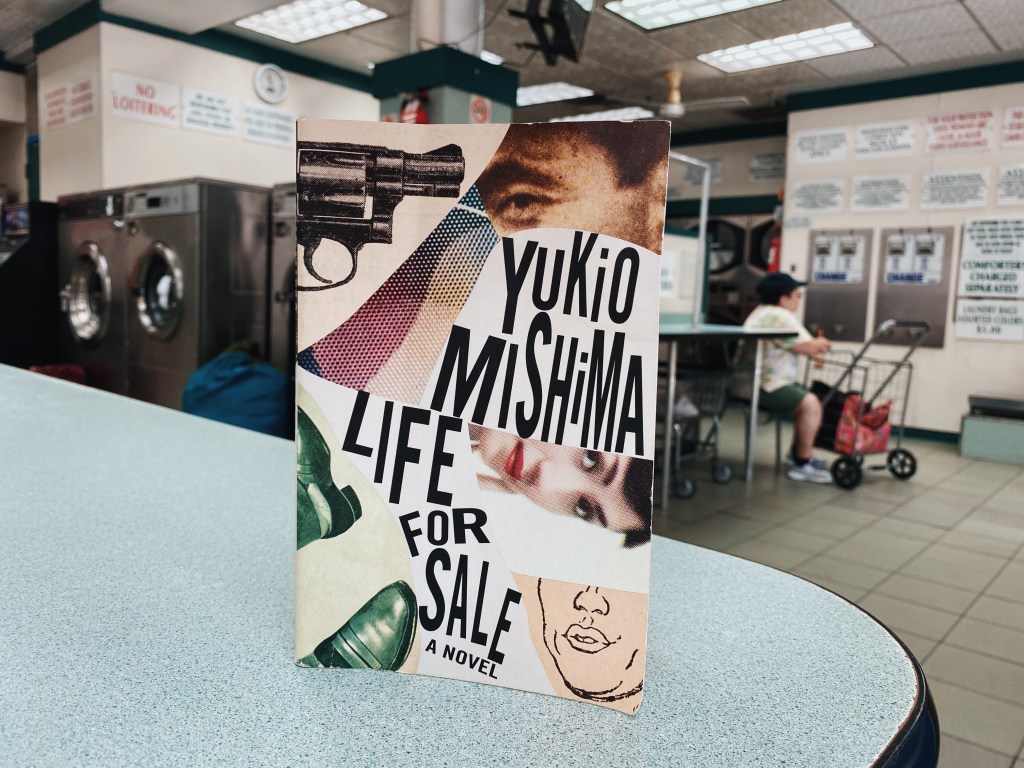
Thus begins the tale of Gregor Samsa, who wakes up one day as a literal vermin, usually interpreted as a cockroach. For the rest of Kafka’s wonderful and strange novella, Samsa tries hard to hold on to the structures and relationships in his life that made him him, before slowly losing his human mind and drifting away into a true bug existence. Yukio Mishima’s Life for Sale begins in a parallel fashion, with its protagonist Hanio Yamada waking up, in his case, from a botched suicide attempt. This attempt is triggered by the very thing Samsa wakes up as: a cockroach. Hanio sees a cockroach running across a sheet of newspaper filled with meaningless headlines: “On top of the fallen paper was a cockroach, absolutely still. At the very moment he stretched out his hand, the glossy, mahogany-coloured insect scurried away with extraordinary vitality and lost itself among the printed words. He picked up the paper nevertheless, placed the page he had been reading on the table and cast his eyes over it again. Suddenly, all the letters he was trying to make out turned into cockroaches. His eyes pursued the letters as they made their escape, their disgustingly shiny dark-red backs in full view” (5).
For many the news helps define the world we live in. In lieu of actually encountering the events in person, we usually only read about them through different forms of news. Yet, many people structure their lives in response to what they read, letting printed word supercede the physical reality around them. When Hanio sees the newsprint turning into a meaningless mass of cockroaches, he is filled with “an overwhelming desire to die… We just have to soldier on even if every word in the newspaper is reduced to a string of cockroaches. It was in reaction to this thought that the idea of ‘death’ finally lodged itself in his mind”(5) Here, Mishima shows in extreme the effect newspapers (content in general) can have on a person’s psyche, no matter how meaningless or vile the former can be. Although he does not explore this phenomenon and its implications very deeply, there is an invitation to think about the impact of the news on a person’s relationship with life. Perhaps: We give them the authority to define reality, authority that is rightfully ours. Perhaps: We let them have too much sway over us all. On the one hand, much of Life for Sale occurs in the theatre of the absurd. Events in this book are so far-fetched, it almost reads like magic realism. On the other, theatre usually holds a funhouse mirror up to real life.
When Hanio is rescued and brought back from death, he finds himself free of the shackles of his old life as a salaryman. He quits his job and puts his life up for sale. For the longest time, he shows no fear of death, placidly and levelly taking on all sorts of challenges that almost cost him his life. Hanio’s response to a cockroach reality is in stark contrast to Gregor Samsa’s: the latter stubbornly clings on — with his spindly legs, hard carapace and all— to everything that gave his life structure, for as long as possible.
What stands out to me the most in all of Hanio’s adventures are the “last wishes” he makes of his clients, in the event that he does die on the missions. His requests range from silly to over-the-top. For example, he asks a woman to use the money she would gain from his death “to buy some large animal— a crocodile, a gorilla… to lavish [her] attention on… give up on marriage completely and spend the rest of [her] life with whichever of these animals [she chooses]… each time [she looks] into its eyes [she’ll] be reminded of [him]” (50). Hanio wants his legacy to be the continued expression of the absurdity and meaninglessness he discovers.
In the end, despite how hard he tries to be blasé, to discard attachment, all his adventures turn out to be linked. They form a net that entangles and smothers him. He discovers that he is in grave danger: he is tracked by powerful and malignant forces that have watched his every move. His actions are connected and significant in spite of him.
In Metamorphosis, as Gregor Samsa loses his human faculties and turns ever more into an insect, his family, still enmeshed in society’s web of meanings, cannot help but reject him. Samsa is ejected from that web and that exile is what kills him. On the contrary, as much as Hanio wishes to be such an exile from the usual structures of meaning-making, he is unable to fully escape. Perhaps his fate is worse than Samsa’s, who disappears off the page and off the face of the earth. The last scene of Life for Sale sees Hanio suspended in a limbo— he is significant enough to be hunted, yet just about absurd enough that he is rejected by those (authority figures) who can help him. First unable to die in peace and now unable to live in peace, he pleads with a deaf and imaginary heaven.
 Hephzibah Grace