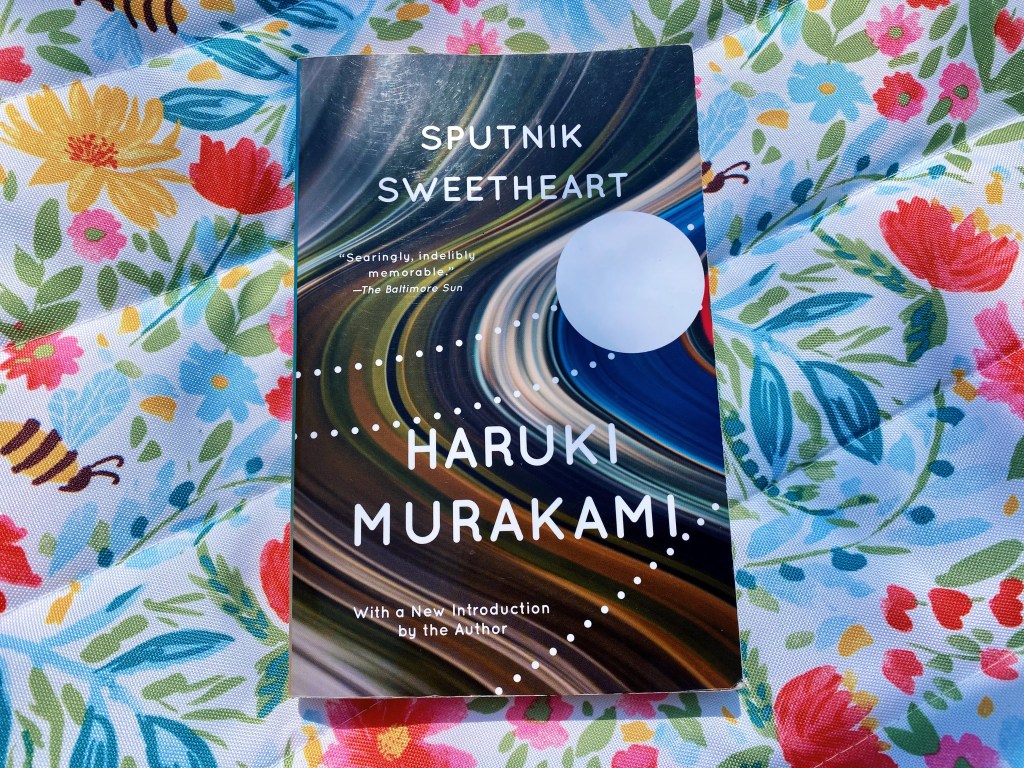
“Lonely metal souls in the unimpeded darkness of space, they meet, pass each other and part, never to meet again. No words passing between them. No promises to keep.”— Sputnik Sweetheart
This quote on satellites, the descendants of Sputnik, reflects Sputnik Sweetheart’s characters’ experiences with relationships throughout the book. The three main characters in it, K, Sumire and Miu orbit around each other. They assuage each other’s loneliness temporarily, but fail to fill a deeper need for connection. There is always something missing: requited love, physical intimacy, a much-craved quality of attention. They brush up against each others’ needs, then pass on before a satisfying conclusion is reached. Nevertheless, the threads that hold them together are vital enough to provide them with reasons to keep going.
K is a single teacher living in Tokyo. He encounters all sorts of people in his everyday. Yet, his relationships remain relatively shallow, transient affairs. They provide a moment of warmth and a suggestion of connection. Then, like satellites, he and them move along with their separate lives. Sumire alone is the exception in his world; she is the warm center, the sun he orbits around. This love is unreciprocated— she, in turn, loves Miu, who cannot love anyone. Murakami suggests through their respective sufferings that even though we may anchor our affections in a place that cannot sufficiently return them, this anchoring is enough to hold us in place. They give us the something vital that keeps us going and without these indifferent and unreliable suns, we lose a source of warmth we have nevertheless come to rely upon. Indeed, when Sumire crosses over from our real, concrete world into the world of dreams, K becomes adrift and uncentered. He compares the memories of them together to a light amidst darkness: “I felt like Sumire and I were together again, our hearts one. This warmed my heart more than anything could. Like you’re riding a train at night across some vast plain, and you catch a glimpse of a tiny light in a window of a farmhouse. In an instant it’s sucked back into the darkness behind and vanishes. But if you close your eyes, that point of light stays with you, just barely, for a few nights” (204). Without Sumire, unrequited love and all, his world goes dark.
Sputnik Sweetheart is a beautiful meditation on the nature of our relationships with others. Through the love triangle of K, Sumire and Miu, the book experiments with the different ways we hold ourselves in relationships and how these postures define us. Most importantly, it shows how a single person can provide so much comfort while simultaneously inflicting a perpetual undercurrent of loneliness and pain.
A lot of Sputnik Sweetheart centers around quiet meditative moments, where K straddles having and not having, letting the contrasting currents of joy and suffering flow through him as he holds Sumire with the knowledge that she can never love him back in the same way. Like the satellites whizzing above his head, he has and loses, is alone and is comforted.
As Kathleen Graber says in “Book Nine” of The Eternal City, “We fill our hands when they are empty. We empty ourselves when he have held too much for too long”.
 Hephzibah Grace