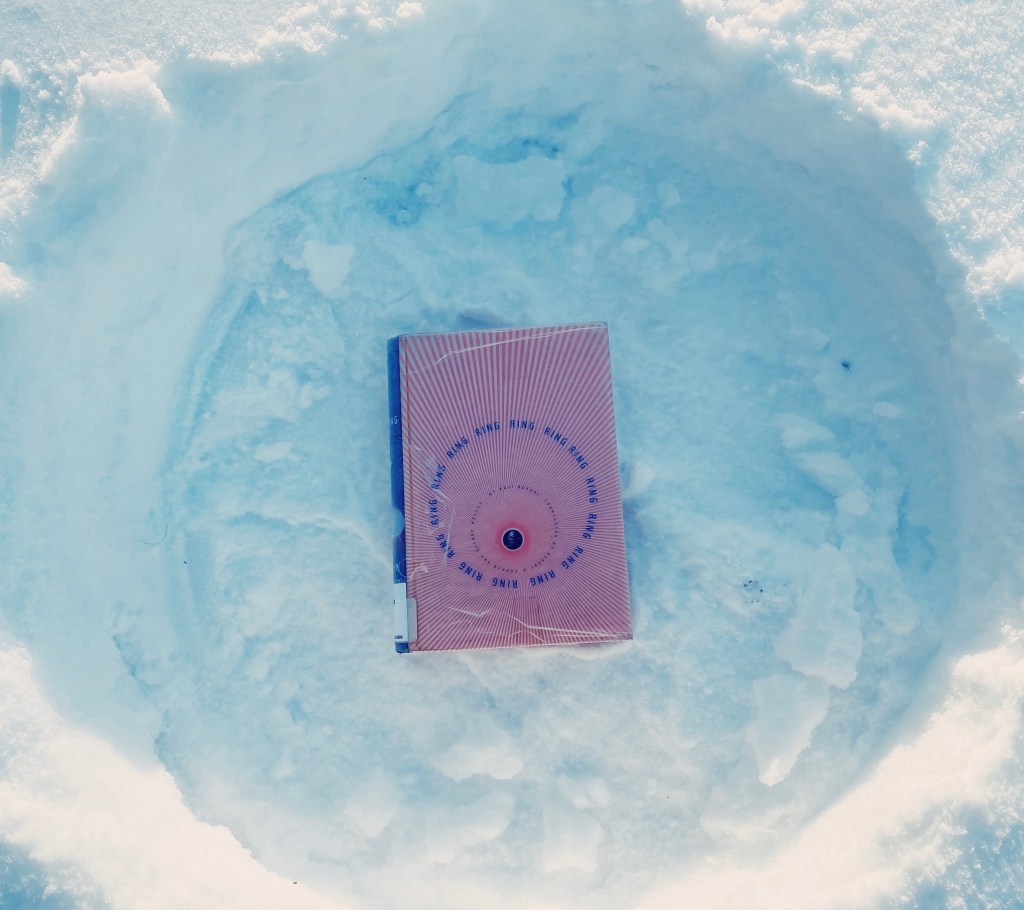
Ring by Koji Suzuki is as much psychological thriller and mystery as it is horror. Set in Japan in the 90s, the novel begins with four teenagers dying at exactly the same time on the same night. Upon dying, they all have horrified looks on their faces and appear to have been trying to tear their hair out before their hearts stopped.
Reporter Asakawa is Ring’s titular character. He has a wife and a baby daughter, although Suzuki makes it clear that Asakawa sees them more as chores than people he loves. Even when his wife’s niece passes away, he hardly pays attention to the news and the impact it may have on his wife’s family. Instead, Asakawa focuses all his energies on chasing the best stories to grow his career. While this makes him a good reporter, it makes him a less-than-ideal husband and father. When he learns by chance that a teenager died suddenly and mysteriously one night, his reporter brain cannot help seeing the connection between this event and his niece’s death and wanting to investigate it for a new story. While the teenagers were far apart physically, they died at exactly the same time on the same night.
Asakawa’s interest in this coincidence catalyses the crux of the story: he watches the infamous cursed videotape produced by Sadako, a woman who lived some decades ago. The video shows a series of disconnected scenes and images, before giving a warning: “Those who have viewed these images are fated to die at this exact hour one week from now. If you do not wish to die, you must follow these instructions exactly…”. The four teenager delete the scene after that, presumably because they think it is a joke. Asakawa, who watches this video after the teenagers’ deaths, knows that this is a real threat.
For the rest of the novel, he and his friend Ryuji work to solve the mystery of the curse. Working methodically, they decode unique features of the individual scenes and what they could mean. Beyond the jump scares now characteristic of the horror genre, Ring actually makes for an extremely interesting read. For instance, when the men watch the video, they can feel the physical and emotional sensations represented in the scenes, as if they were physically and personally experiencing the events portrayed. Suzuki also makes some references to Japanese cultural history like saints and demons and these play a big part in Asakawa and Ryuji’s search for answers.
The novel’s title, Ring, is symbolically significant on multiple levels. Literally, it describes a key scene in the video tape and in Sadako’s life: the view of the sky from the bottom of the well. For Sadako, this view meant the end; for the men, it is a key, a sliver of hope. For Asakawa, a ring represents a full circle— his journey to decipher the curse finds him traveling far and wide before eventually coming back to where he started. Finally, it also symbolises the way the virus of the curse spreads out, like ripples across a pond’s surface.
For me, the best part of the novel was its ending. The novel ends on the brink of a catastrophe starting. Although the story moves somewhat slowly throughout— at times almost ponderously— the ending puts the pedal to the metal, as Asakawa races against time to save his family and birth the beginning of a pandemic.
 Hephzibah Grace