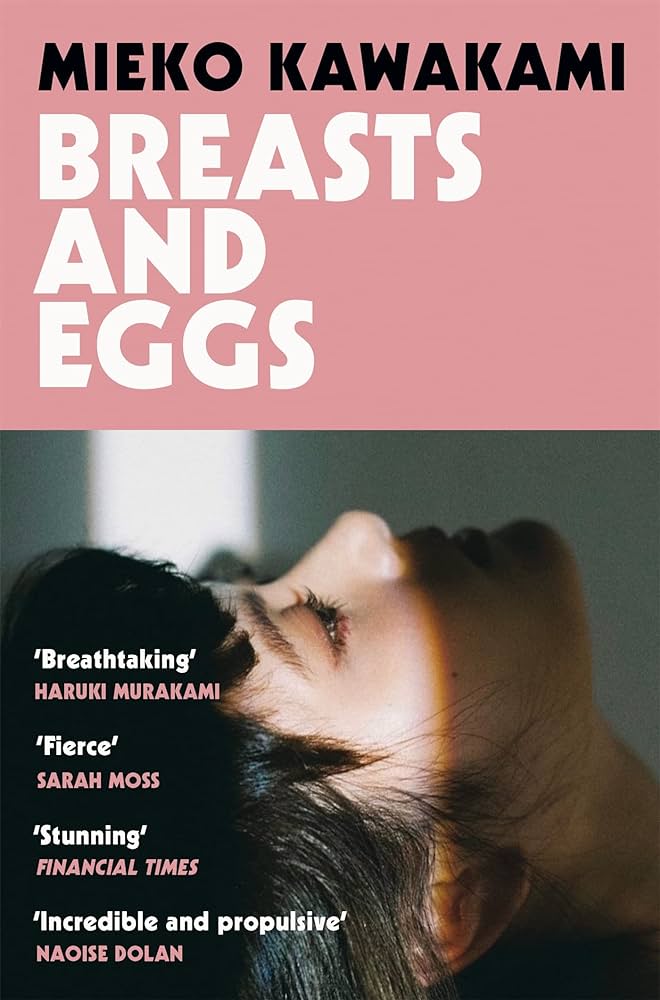
Mieko Kawakami’s Breasts and Eggs is told from protagonist Natsuko Natsume’s perspective. It follows her life from the time she is a child to the present day in her late thirties. While she is single and lives alone, her social life is rich. She is surrounded by a large variety of women, all occupying different social positions shaped by vastly different life paths. Through Natsuko and these women, Kawakami presents the kaleidoscope of experiences and struggles women young and old have: periods, body image, marriage and relationships, both with others and themselves. All of them have varied opinions on these topics. Some are filtered through Natsuko’s own thoughts while others are simply recorded down. These array of everyday concerns, together with Natsuko’s all-too-human reactions to them makes Breasts and Eggs a highly relatable and relevant prism of womanhood.
Natsuko and Makiko
The novel’s main storyline begins when Natsuko, her sister Makiko, and their mother flee from a seaside town to Osaka. After their mother and grandmother die, the two sisters must fend for themselves, working hard at a bar. Makiko gets pregnant shortly after, and their lives deviate into two vastly different paths. In the present day, Makiko still works at the same bar while Natsuko lives in Tokyo, getting paid a comfortable wage as a writer. It is explicitly and implicitly acknowledged that this difference is specifically caused by Makiko’s having a child (Midoriko). Without a kid, Natsuko has the freedom of time and money to move up in class and eventually pursue a better career and lifestyle. However, as time goes on, Natsuko craves her own child and the experience of motherhood. Being asexual, this is especially difficult to achieve. The positive result of this is more time to develop her talents and portfolio which lets her achieve a better and better life. The sisters hence portray two different options for women who do not start out particularly rich: having kids young and having that ‘need’ to experience motherhood satisfied at the expense of money and freedom, or not having kids till much older (hence risking not having kids at all), but in return experiencing a level of personal freedom and career development that motherhood may otherwise hinder.
Different Women’s Perspectives
In Natsuko’s quest to have a child and in her career as a writer, she makes friends with a variety of women. They all have different life paths that many women probably occupy in real life together with strong opinions on the subject of having kids.
These include:
- The rich single career woman who’s never had kids and strongly believes that having them hinders a woman’s talent.
- The not-as-rich but still well-off-enough single career woman with a child who tells Natsuko that willpower is all a woman needs to make both motherhood and a career work.
- Makiko, who has been stuck in the same dead-end job for over twenty years after becoming a teen mom.
- A woman who was severely abused for years growing up and has seen many other children suffer debilitating conditions. She believes that giving life to a child is too risky— there is always a chance any of them is born to inadequate parents, or has an unlucky genetic condition that means nothing but suffering.
Amidst all the arguments and opinions Natsuko encounters about having a child, she holds on firmly to her own. That is: she wants to know the child; to have a relationship with this unborn person. Likewise, relationship trumps all else in the novel too— no matter what social roles and privileges her friends have, Natsuko is mainly invested in her personal relationships with them. It is what keeps them coming back to each other no matter what. In many cases, their differing opinions seem to test how strong their bonds are— can they withstand the stress of opposition? After Natsuko loses a friend because she gets offended by their words, she cares more about who they were to her than what was said.
Breasts and Eggs
At the start of Breasts and Eggs, breasts are a sort of a weapon, or a curse. Makiko is severely unhappy with her breasts, and wants to have a boob job. She wishes to voluntarily commit an invasive act of violence toward her own body in order to satisfy society’s expectations of women’s bodies. Eggs are problematic as well. Midoriko is about to start her periods and is horrified by what they mean for her body. She blames her mother for having her and vows never to have her own kids. Both these symbols of womanhood appear to create nothing but self-hatred and stress. However, as the novel progresses, the significance of breasts and eggs transforms. Breasts and Eggs starts with Natsuko seeing a girl who reminds her of the abject poverty she herself grew up in. Although she wants to say something comforting to this girl, she does not get to. She loses sight of this girl. Similarly, the novel begins with her being alienated from her younger self. At the same time, she, Makiko and Midoriko are looking for each other at a busy train station and failing. The novel begins with alienation and loneliness, both within and without.
Natsuko’s quest to have a child occurs alongside her memories into the past. As she retraces her steps back into childhood both literally and figuratively, it is the presence of others in her life that ground her in the present. Relationships are what matter the most.
By the end of the novel, despite their vast variations in lifestyles and philosophies, Natsuko is surrounded by the love of her family and friends. Her life is deeply interconnected with theirs. Breasts become a place of comfort, something others can cry into. Eggs become the means by which a person can expand their family; to add into their lives another person to love.
Breasts and Eggs seems therefore to be a novel ultimately about the bonds that make or break us. As much as it is about womanhood and motherhood, it is also about how all these dissimilar women hold on to their friendships despite life’s many tests and turns.
 Hephzibah Grace
3 thoughts on “Mieko Kawakami’s Breasts and Eggs: To Let Her Cry Into My Breast”